
Why We Invested in Atom Computing
Toric codes, $100M from the US Government, and scaling to 10k qubits and beyond.

On June 3, Atom Computing announced the first full demonstration of quantum error correction using a toric code on neutral atoms. Logical error rates fell as more physical qubits were added. Logical information survived even as lost atoms were replaced mid-run, characterized out to 90 cycles of syndrome extraction. Syndrome extraction is a repeating measurement cycle that locates errors without looking at (and destroying) the encoded data itself. Ninety cycles means the machine found and fixed errors round after round and the information was still alive at the end. Useful algorithms need error correction running for the full depth of the computation.
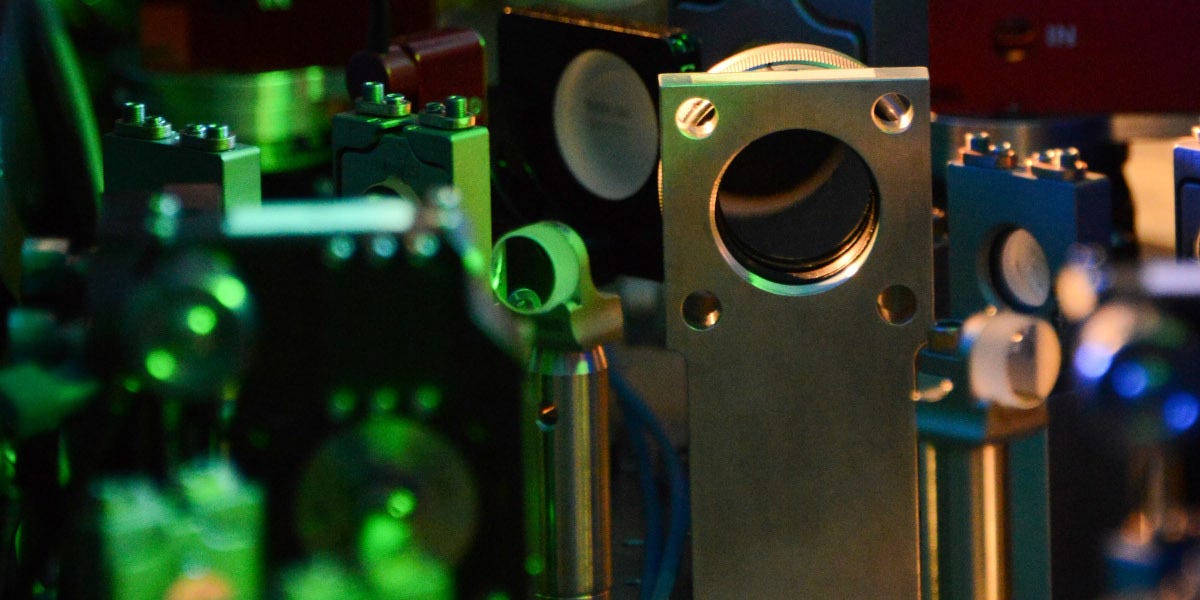
Pleased to invest alongside Third Point Ventures, DCVC, and Cisco Investments in the Atom Computing Series C in March 2026. Since closing, Atom was also selected to receive $100 million in planned funding under the Commerce Department’s $2 billion CHIPS quantum initiative.
What are neutral atoms?
Neutral atoms spent two decades as the platform physicists loved and capital ignored. Since 2015 (and even prior, with D-Wave being around much longer than most companies in the space), capital favored superconducting qubits. But, the toolkit (laser cooling, optical tweezers, Rydberg interactions) is mature AMO physics with Nobel prize wins. I personally remember going to DAMOP in 2011 and talking to superconducting qubit people about my neutral atom quantum memories experiments. And their comments were “well, our coherence times are nowhere close to yours”.
But it didn’t look as cool as the steampunk chandelier — Devs and every other show that needs a quantum computer on screen had to have it (I argue lasers are super cool too!).
That changed between 2019 and 2023. Rydberg gate fidelities crossed into seriousness, and Atom Computing crossed 1,000 physical qubits: a 1,225-site array populated with 1,180 qubits, announced October 24, 2023.
For neutral atoms, every atom is identical. Nature has zero manufacturing variance between qubits because we don’t manufacture them. Nuclear-spin qubits hold coherence for a long time. The atoms can be physically rearranged mid-computation. You’re not wired to a fixed layout. Any qubit can talk to any other qubit.
But as always, for every modality, there are tradeoffs. Gates are slower than superconducting. Mid-circuit measurement, reading out some qubits without disturbing their neighbors while the computation keeps running, is harder, and error correction needs it constantly. A lead in logical qubits is not automatically a lead in logical operations per second. However, as with every modality, companies and academic groups have been attacking engineering, scaling, and science problems. It feels like we are going to make it after all.
Atom’s roadmap in this Series C invests in the engineering problems: laser technology for high-efficiency photon capture, gate speeds, interconnects and modularity, a path to 10,000 qubits, and a working hypothesis around the roadblocks to 100,000 qubits per system.
The reconfigurability pays off in error correction, too. Codes are increasingly matched to hardware, not chosen in the abstract: IBM’s roadmap is built on qLDPC codes, Google is scaling surface code distance below threshold, and your connectivity decides which codes are cheap on your machine. Movable atoms mean you’re not locked into the code you taped out.
For neutral atoms, that also means non-stabilizer error correction options are getting real. Permutation-invariant codes got their first general recipe in February 2026 from Yingkai Ouyang (Sheffield) and Gavin Brennen (Macquarie and BTQ), built on the idea that it doesn’t matter which qubit broke, only that one broke. The scheme needs global control fields, one signal addressing every qubit at once instead of qubit-by-qubit wiring, plus a shared bosonic bus: a single quantum channel all the qubits talk through. That is a fit for a neutral-atom array. If the non-stabilizer branch matters, neutral atoms are disproportionately positioned to run it.
QPUs are GPUs, not CPUs
This is not a bet against classical computing, superconducting, trapped ions, or whatever modality gets invented next. We invest across the physics-infrastructure-software stack where new compute becomes usable.
Quantum processors will not replace classical computers. They’ll sit inside classical HPC and AI datacenters as accelerators, invoked for the subroutines where they win, orchestrated by classical infrastructure. The same way GPUs were absorbed into the computing stack rather than standing apart from it.
We see hybrid orchestration layers like NVIDIA’s NVQLink, Atom’s hardware integrated with Azure’s software stack, and the DOE RFI that asks vendors about compilation and system management environments, not just qubits. Quantum is being absorbed into accelerated computing, not built as a parallel universe.
Atom Computing x Microsoft x DARPA x US Government
On November 19, 2024, working with Microsoft (a partnership that goes back years), Atom created and entangled 24 logical qubits, then ran Bernstein-Vazirani, a standard benchmark algorithm, on 28 logical qubits with error-corrected results. Atom has also signed a sale of a quantum computer with logical qubits: Magne, the 50-logical-qubit system for QuNorth in Denmark, announced July 17, 2025.
Atom was selected for Stage B of DARPA’s Quantum Benchmarking Initiative on November 6, 2025, and on May 21 signed a letter of intent with the Commerce Department’s CHIPS R&D Office for $100 million, part of a $2.013 billion federal quantum initiative spanning nine companies. While the letter is non-binding, the government equity stake is a signal of its commitment to investing in modalities that are delivering now.
A bet on Atom is also a bet on the quantum ecosystem and its supply chain as a whole. The CHIPS funding is earmarked for in-house development of critical components, parallelized testbeds, and deeper supply chain partnerships. The lasers, photonics, and control electronics built to scale one neutral-atom company get bought by other quantum and non-quantum technologies, and increasingly by the classical datacenter industry. It’s all building into the bigger heterogeneous compute era.
Quantum is also becoming a talent war, and the talent is moving toward atoms. Google entered neutral atoms in March, not by buying a company, but by hiring one person: Adam Kaufman from JILA, now standing up a hardware team in Boulder. When the company with one of the deepest superconducting programs in the world starts chasing this modality, that tells you something about neutral atoms place in the world.
Atom Computing has a great team, honest growth, and sales of full systems. Thank you to Curtis McKee and Rob Schwartz from Third Point Ventures for conversations, and Ben Bloom for the lab tour in Boulder, Colorado. We’re excited to be a part of the future of Atom Computing and Quantum Computing as a whole!